Queer Places:
Cornell University (Ivy League), 410 Thurston Ave, Ithaca, NY 14850
University of Virginia, Charlottesville, VA, United States
Kipling House, 43 Villiers Street, Charing Cross, London WC2N 6NE, United Kingdom
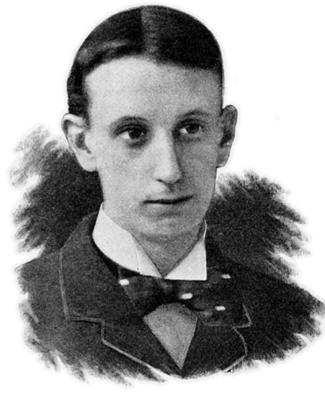 Charles Wolcott Balestier (December 13, 1861 - December 6, 1891) was born on December 15, 1861, in Rochester, Monroe County, New York, to Henry Wolcott
Balestier and Anna (Smith) Balestier. His paternal grandfather was Joseph Nérée Balestier, a remarkably gifted lawyer and writer whose ancestors were from
Martinique and who was a founder of the prestigious Century Association. His maternal grandfather was E. Peshine Smith, who worked alongside Commodore
Matthew Perry to complete vital commercial negotiations with Japan. Balestier's immediate family included his siblings Caroline Starr "Carrie" Balestier
Kipling, Beatty Smith Balestier, and Josephine Balestier Dunham. His educational path included studying for one year at Cornell University and spending a
summer studying law in 1883 at the University of Virginia. He briefly worked at the Rochester Post Express and later ran his own newspaper in Rochester.
Even in his youth, he showed an early dedication to literature, beginning to send stories to the Atlantic Monthly—then edited by William Dean Howells—at
age seventeen. His first published work, a story entitled "A Patent Philter", appeared serially in the daily New York Tribune in 1884. That same year, he
published his first novel, A Fair Device, alongside a campaign biography for presidential candidate James G. Blaine, followed by the publication of A
Victorious Defeat in 1886.
Charles Wolcott Balestier (December 13, 1861 - December 6, 1891) was born on December 15, 1861, in Rochester, Monroe County, New York, to Henry Wolcott
Balestier and Anna (Smith) Balestier. His paternal grandfather was Joseph Nérée Balestier, a remarkably gifted lawyer and writer whose ancestors were from
Martinique and who was a founder of the prestigious Century Association. His maternal grandfather was E. Peshine Smith, who worked alongside Commodore
Matthew Perry to complete vital commercial negotiations with Japan. Balestier's immediate family included his siblings Caroline Starr "Carrie" Balestier
Kipling, Beatty Smith Balestier, and Josephine Balestier Dunham. His educational path included studying for one year at Cornell University and spending a
summer studying law in 1883 at the University of Virginia. He briefly worked at the Rochester Post Express and later ran his own newspaper in Rochester.
Even in his youth, he showed an early dedication to literature, beginning to send stories to the Atlantic Monthly—then edited by William Dean Howells—at
age seventeen. His first published work, a story entitled "A Patent Philter", appeared serially in the daily New York Tribune in 1884. That same year, he
published his first novel, A Fair Device, alongside a campaign biography for presidential candidate James G. Blaine, followed by the publication of A
Victorious Defeat in 1886.
Around 1884, the John W. Lovell Company in New York City appointed him editor of their magazine Tid Bits, which he successfully renamed Time. In 1889,
Balestier was sent to Europe as a literary agent and to purchase literary copyrights for the Lovells. In this dynamic profession, he quickly became
acquainted with the leading British authors of the day. He developed a particularly close relationship with
Henry James, who wrote in 1890 that "I have lately seen much of the admirably acute and intelligent young
Balestier." Around that same time, writer and critic Edmund Gosse described Balestier as possessing a "mixture of
suave Colonial French and the strained nervous New England blood.... a carefully dressed young-old man or elderly youth, clean-shaven, with smooth dark
hair, thin nose, large sensitive ears, and whimsically mobile mouth." Gosse also praised his staggering grasp of the contemporary literary landscape,
noting he had never met anyone "who had anything like his power of marshaling before his memory, in due order, all the militant English writers of the
moment, small as well as great." From 1889 to 1891, Balestier worked with William Heinemann to establish the firm Heinemann & Balestier, publishing English
and American books in Europe, including the Review of Reviews in London and The English Library series in continental Europe. He was widely regarded as
possessing a keen business sense paired with a deep knowledge and appreciation of literature, making him very popular with authors.
In 1889, Balestier's life and career reached a new defining milestone when he met the rising young British author
Rudyard Kipling in Europe. A warm friendship sprang up between the two young men, and they formed an intense,
deeply intimate collaboration, sharing lodgings in London and planning a number of novels together. Their primary collaboration resulted in the novel The
Naulahka: A Story of West and East, with Balestier providing the material for the rail-roading scenes, which was published in 1892 after his death.
Additional works of his own, including The Average Woman (1892) and Benefits Forgot (1893), were also published posthumously.
In 1891, Balestier's health began to fail, and his mother and sister, Caroline Balestier, took him to Europe. Tragically, he contracted typhoid fever
and died on December 6, 1891, at the age of twenty-nine in Dresden, Germany. His death sent shockwaves through the literary community. Henry James traveled
to Dresden for the funeral, later describing how "The English chaplain read the service with sufficient yet not offensive sonority, and the arrangements
were of an admirable, decorously grave German kind." Henry Adams similarly captured the heavy sense of loss among their circle, writing, "I sat with Henry
James an hour or two yesterday afternoon and found him in double trouble between the death of his friend Balestier and the steady decline of his sister."
In an obituary published in the New York Times, William Dean Howells reflected on Balestier's immense potential, stating that he knew him quite well and
that "Mr. Balestier would have achieved great fame had he lived a few more years."
Balestier was reported to have been buried in the American cemetery at Dresden, Germany, though specific modern burial plot locations remain difficult
to verify. It is noted that Caroline and Rudyard Kipling first became deeply attracted to one another while she and her mother were caring for Wolcott
during his illness, and it was reportedly Balestier's wish that their marriage take place as soon as possible after his death. Caroline and Rudyard were
married in London on January 18, 1892, just six weeks after Wolcott died.
Wolcott Balestier never married a woman, died young before traditional domestic expectations could fully take root, and lived entirely within the covert
homosocial conventions of Victorian literary society. However, modern biographers, queer studies scholars, and literary historians examining
late-nineteenth-century homosocial networks have frequently analyzed Balestier's intense, emotionally absorbing relationships with other men, most notably
Rudyard Kipling. Biographer Martin Seymour-Smith and other critics have pointed to the profound romantic intensity of Kipling and Balestier's shared
domestic and professional life in London as an expression of deep, albeit socially unacknowledged, same-sex romantic attachment. Within the rigid moral and
legal frameworks of late-Victorian Britain—where the Criminal Law Amendment Act of 1885 severely penalized homosexual acts—such deep homosocial pairings
among unmarried literary men frequently served as a socially acceptable conduit for passionate emotional and creative partnerships. While documentary
evidence of overt physical intimacy between Balestier and Kipling remains absent due to Victorian discretion and the subsequent vetting of papers by
surviving relatives, the extraordinary emotional dependency Kipling demonstrated toward Balestier—and the lingering, lifelong grief that marked Kipling's
memory of him—lead contemporary scholars to view their bond as a prime example of nineteenth-century romantic friendship imbued with latent queer
dynamics.
References:
- Seymour-Smith, Martin. Rudyard Kipling: A Biography. New York: Holt, Rinehart and Winston, 1989.
- Carrington, Charles. Rudyard Kipling: His Life and Work. London: Macmillan & Co., 1955.
- Gosse, Edmund. Critical Kit-Kats. London: William Heinemann, 1896.
- James, Henry. The Letters of Henry James. Edited by Leon Edel. Cambridge: Belknap Press of Harvard University Press, 1974–1984.
- Adams, Henry. Letters of Henry Adams. Edited by J.C. Levenson et al. Cambridge: Belknap Press of Harvard University Press, 1982–1988.
- Howells, William Dean. "Obituary of Wolcott Balestier." New York Times, December 1891.
- The Atlantic Monthly and The Century Magazine (Various 1884–1892 issues).
Support this project
This website is a passion project researched, developed, and funded entirely by me. If you find the content valuable and would like to help support the ongoing research and hosting costs, any contribution is deeply appreciated.
Thank you for keeping this independent resource alive!
My books on Amazon: Elisa Rolle's books
BACK TO HOME PAGE